Trust Is a Decision. Someone Has to Sign It.
2026-11-24 · Aldo Pietropaolo
Part 2 of Proof Before Production, a five-part series on how to earn trust in AI agent workflows with evidence your security, risk, and audit teams can stand behind. Part 1 covered the trust gap and the four pieces of evidence that close it.
Most agent workflows never get a clear yes or a clear no. They sit in pilot, collect another round of review, and wait. In Deloitte's 2026 State of AI in the Enterprise report, "only 25% of respondents have moved 40% or more of their AI pilots into production" (Deloitte, January 2026).
The usual explanation is that the technology is not ready. This year's research points somewhere else: nobody is sure whose name goes on the decision.
Nobody owns the yes
ISACA asked more than 3,400 digital trust professionals who would be accountable if AI went wrong. In its words: "when it comes to who is ultimately responsible if an AI system causes harm or serious error in their organization, respondents largely point to their board/executives (28 percent). Eighteen percent believe that their CIO/CTO would be responsible, 13 percent assign the responsibility to their CISO, and 20 percent admit that they do not know where the responsibility would lie" (ISACA, March 2026).
No answer gets more than 28%. One respondent in five does not know. The same poll found "only 36 percent of respondents saying humans approve most AI-generated actions before execution."
When accountability is that spread out, every reviewer can say no and nobody can say yes. Security waits for the business to accept the risk. The business waits for security to bless the controls. Risk waits for both. The workflow waits for everyone.
ISACA's Chief Global Strategy Officer, Chris Dimitriadis, put the first step plainly: "That starts by establishing who is accountable" (ISACA, March 2026).
A policy does not approve a workflow
Most large companies already have an AI governance policy. EY found that "almost all senior AI executives (98%) report having formal AI governance policies in place," yet "About half (47%) of the respondents have even admitted that their organization has previously not followed its AI governance process for urgent deployments." And "Roughly half (49%) of respondents whose organization uses agentic AI say their organization's existing governance framework has not yet been updated to specifically include agentic AI requirements and risks" (EY, September 2026).
A policy says how decisions should be made. It does not make one. Each agent workflow touches different systems, acts on behalf of different people, and fails in different ways, so each one needs its own decision.
NIST's AI Risk Management Framework describes that decision directly. MANAGE 1.1 reads: "A determination is made as to whether the AI system achieves its intended purposes and stated objectives and whether its development or deployment should proceed." GOVERN 2.3 says who owns it: "Executive leadership of the organization takes responsibility for decisions about risks associated with AI system development and deployment" (NIST AI 100-1).
Skipping that decision does not save time. When EY's respondents ran a formal assurance review on AI already in use, "29% paused a quarter or more of their AI systems" and "25% fully stopped a quarter or more of their AI systems." Deciding before production is cheaper than deciding after.
Government already wrote the template
US federal agencies have had to make this decision since 2025. OMB Memorandum M-25-21 says "Agencies must complete an AI impact assessment before deploying any high-impact AI use case." The assessment must be "supported by an independent reviewer within the agency who has not been involved in the development," and it ends in "risk acceptance, supported by a signature from the individual accepting the risk." Before that, "Agencies must develop pre-deployment testing and prepare risk mitigation plans that reflect expected real-world outcomes." If a use case cannot meet the minimum practices, "the agency must safely discontinue use of the AI functionality" (OMB M-25-21, Section 4).
That is a production decision in four parts: test before you deploy, have someone independent review it, have a named person sign for the risk, and stop if it does not hold.
Singapore's framework for agentic AI starts from the same point. "The organisations that deploy agents and the humans who oversee them remain accountable for the agents' actions," it says, and warns that "Multiple stakeholders may also be involved in different parts of the agent lifecycle, diffusing accountability." Its advice once the decision is made: "Once the ‘green light’ is given to deploy agentic AI, an organization should take immediate steps to make humans meaningfully accountable" (IMDA, Model AI Governance Framework for Agentic AI, Section 2).
The EU AI Act points the same way for high-risk systems. Article 26 says "Deployers shall assign human oversight to natural persons who have the necessary competence, training and authority, as well as the necessary support" (AI Act Service Desk, Article 26).
Banks are on their own with agents
In April 2026 the Federal Reserve replaced SR 11-7, the model risk guidance banks have built around for fifteen years, with SR 26-2. It leaves agents out on purpose: "Generative AI and agentic AI models are novel and rapidly evolving. As such, they are not within the scope of this guidance. Nonetheless, a banking organization's risk management and governance practices should guide the determination of appropriate governance and controls for any tools, processes, or systems not covered in this document" (Federal Reserve, SR 26-2, footnote 3).
So a bank cannot point to a regulator's checklist for an agent that moves money. It has to make the call itself and be ready to defend it. SR 26-2 still describes who can credibly challenge that call: "Effective challenge is performed by individuals with the appropriate expertise to conduct a critical and objective challenge, sufficient independence to maintain objectivity, as well as the organizational standing and influence to effect any change." That is a good test for anyone you ask to sign an agent decision.
The workflows waiting for a decision
Watchlight's research agents study companies likely to adopt AI agents, using public sources only. Of the 202 companies they researched between October 23 and November 6, 2026, 61 (30%) are building agents now, on top of the 101 already in production. Those 61 are heading toward the decision this post is about.
The work they are pointing agents at raises the stakes. The most common use case we found is payments and money movement, at 21 companies, followed by claims and underwriting at 14. Fraud, trading, and credit and lending follow further down the list.
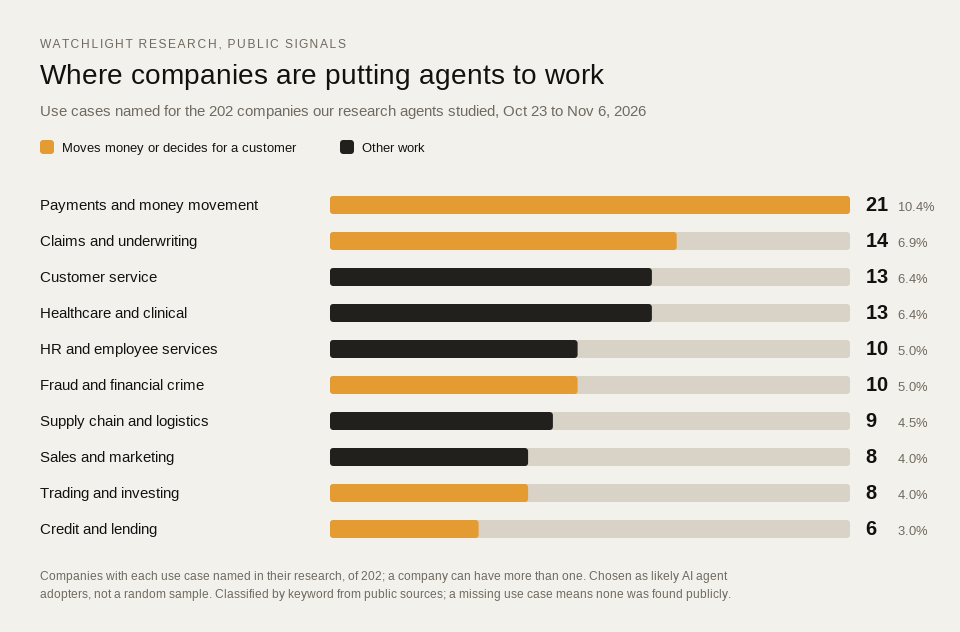
These companies were chosen as likely agent adopters, so they are not a random sample. Use cases are classified by keyword from each company's research, and a company can have more than one.
An agent that drafts marketing copy can ship on a manager's say-so. An agent that releases payments or settles claims needs a decision a regulator, an auditor, or a board can read later and understand.
What a production decision on one agent workflow contains
A decision someone can sign has five parts. Write them down for each workflow.
- The workflow and its authority boundary. What the agents may do, on whose behalf, with which tools and data, what is off limits, and which actions need a person's approval. This is the thing being approved.
- The evidence. The tests that tried to push the agents outside that boundary, a stop shown to work on a live run, and a record that ties each governed action to who authorized it and which policy decided it. Part 1 covered these.
- The risks that remain. Every workflow keeps some. Name them, so the person accepting them knows what they are accepting.
- The outcome and its conditions. Go, go with conditions, or not yet. Conditions are specific: refunds above a set amount wait for a person, or the decision is reviewed again before the agent gets a new tool.
- The signatures. One per role, each signing for what they own.
The roles map cleanly onto the people already in the room:
- The business owner signs for the value and accepts the remaining risk. In the terms of OMB M-25-21, this is the individual accepting the risk.
- Security signs that the authority boundary is enforced where the agents act and that the tests ran against it.
- Risk and compliance sign that the rules that apply to the workflow are mapped to evidence the workflow produces.
- An independent reviewer, often internal audit or a second-line risk team, challenges all of it before anyone signs.
A decision also has a shelf life. Agents change faster than most systems do. A new model, a new tool, a new data source, or a change to the policy should send the workflow back for review, and the decision record should say so.
How we help teams make the decision
We work on this problem every day, with the people who have to sign. Our services follow the order most teams take:
- Not sure which workflow is ready to decide on? The Agent Workflow Fit & Readiness Assessment maps up to three planned or active workflows in two to three days and tells you which one to take to a decision first.
- Need to settle who an agent acts for? Agentic IAM Architecture designs agent identity, credentials, and delegated authority around the IAM, PAM, and IGA you already run, whichever vendors they are.
- Ready to decide on one workflow? The Production-Readiness Pilot writes the authority boundary and the pass and fail criteria with you, gathers the evidence on that workflow, and ends with a go, go with conditions, or not yet that your security, risk, and business owners sign. The boundary, tests, and review then become the template for your next workflow.
- Need to show which rules apply? The Agent Compliance Map lays out what nine frameworks, including the EU AI Act and NIST AI RMF, ask of AI agents.
Agent Runtime Governance is what makes a decision like this one worth signing. The boundary is enforced while the agents run, and the evidence comes from the run itself.
The rest of the series
- Part 1: AI Agents Are Shipping. Trust Isn't Keeping Up. The trust gap, and the four pieces of evidence that close it.
- Part 3: Prove it before you ship. Testing your agents on purpose against the ways access stops being enough.
- Part 4: When it goes wrong anyway. Why being able to stop a run in progress is part of trusting it.
- Part 5: The evidence regulators will ask for. The EU AI Act, US state rules, and NIST work on agent identity, mapped to what a governed run produces.
Five questions to ask before your next agent decision
- Which agent workflow is closest to production, and whose name goes on the decision?
- Is its authority boundary written down, or does it live in the developers' heads?
- Who outside the team that built it has challenged the evidence?
- Which risks will remain after it ships, and who has agreed to accept them?
- What change to the agents, their tools, or the policy sends it back for review?
Bring us the agent workflow waiting on a decision. Scope a production-readiness pilot and leave with a decision your security, risk, and business owners have signed, or request a demo to see the evidence a governed run produces.