
AI Security Is Not Enough: The Case for Agent Runtime Governance
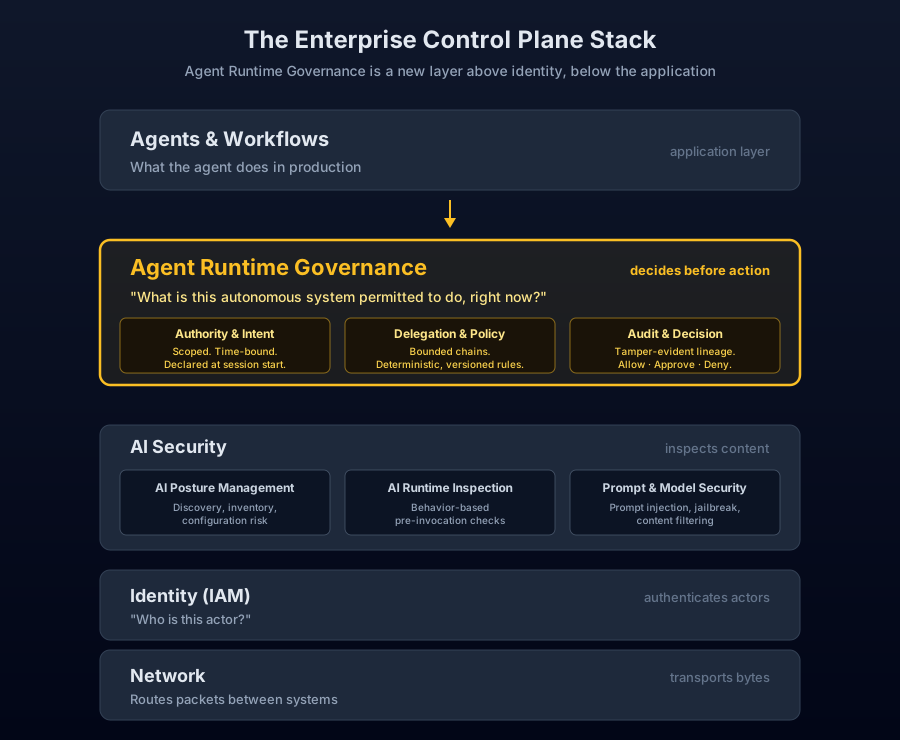
A new control plane is forming above identity and below the application. It is not a feature of AI security. It is the next operational layer of enterprise infrastructure.
Bottom line for CISOs. AI security inspects content. Agent Runtime Governance enforces actions. Both are necessary; neither replaces the other. Autonomous agents run at machine speed and can compose granted authorities into outcomes no human would, which is why detection-after-the-fact cannot match the blast radius. A new layer is forming, and the enterprises that recognize it early will deploy autonomous agents on infrastructure they can actually defend. Watchlight AI Beacon is that infrastructure.
Enterprise AI is shifting from chat assistants that respond to humans into autonomous operators that act on enterprise systems with little or no human review at each step. The existing AI security ecosystem (prompt-injection detection, model scanning, LLM firewalls, AI posture management, output filtering, observability) is necessary, valuable, and well-funded. It is also primarily a detection and inspection layer. It tells you what AI is doing, sometimes what it tried to do, and increasingly what it might be about to do.
That is not enough for autonomous systems. When agents act at machine speed, chain dozens of tool calls per minute, and delegate to sub-agents, observed-after-the-fact security cannot match the blast radius. The enterprise needs a different layer: a runtime control plane that decides, in real time and against current policy, what an agent is actually permitted to do given its intent, authority, delegation chain, and runtime context.
This is Agent Runtime Governance (ARG). AI security inspects. Runtime governance enforces. They are not in competition. They are different floors of the same building.
From Chat Assistants to Autonomous Operators
Autonomous AI is not a new content surface. It is a new class of privileged actor inside the enterprise.
For three years, "enterprise AI" predominantly meant a chat interface. A user typed something. A model responded. The model never directly accessed production systems. If the response was harmful, the human reading it could ignore it.
That model has collapsed. The systems being deployed in 2026 are not chatbots with tool calls bolted on. They are autonomous operators with persistent capabilities:
- They invoke real APIs against real systems.
- They access internal databases, ticketing platforms, file stores, and CRM data.
- They write records to accounts payable, modify CRM opportunities, send vendor email, and trigger workflows.
- They orchestrate other agents and delegate work down a chain of sub-agents.
- They operate continuously, often outside the working hours of the team that deployed them.
- They form opinions about their own plan and revise it as they execute.
The shift in the security model is not incremental. A human user clicking through a workflow gives the security team observable, paced, naturally rate-limited execution. An agent running the same workflow can compose dozens of granted authorities in seconds. The granted authorities are individually reasonable. The composition can be catastrophic. Human users do not chain "read customer PII," "write to outbound email," and "fetch external URL" into a single autonomous action loop. Agents will, if their declared goal drifts.
Autonomous AI is not a new content surface. It is a new class of privileged actor inside the enterprise.
This is the architectural premise of everything that follows.
Why Existing AI Security Is Necessary but Insufficient
Detection layers govern content. They do not govern actors.
The AI security category that emerged in 2023 through 2025 was built around the dominant threat model of that era: humans interacting with chat models, with models occasionally being prompted to misbehave. The category produced real value:
- Prompt-injection detectors flag adversarial inputs before they reach the model.
- Model-security tools scan for embedded vulnerabilities and unauthorized weights.
- LLM firewalls sit in front of model APIs and inspect requests and responses.
- AI posture management catalogs which models, datasets, and prompts an organization is running.
- Content filtering and DLP-style controls block sensitive outputs.
- Jailbreak detection identifies attempts to bypass system instructions.
- AI observability captures token usage, latency, and model behavior over time.
These capabilities are necessary. They will continue to be necessary. None of them are wrong. But each is principally a detection or inspection layer. They observe the conversation between a human and a model, or between a model and another service, and they classify it. Some are passive observers. The best are inline blockers that drop bad traffic before it reaches the model or the user.
That model has a hard limit. It governs the content moving between actors. It does not govern the actor. When the actor is an autonomous agent with the authority to invoke a payment API, the content of its prompt is largely beside the point. The relevant question is whether the agent should be allowed to make the call at all, given its declared intent, its delegation chain, and current organizational policy. That question lives outside the inspection layer.
This is not a critique of the AI security ecosystem. It is a statement about scope. Detection tools answer "is this interaction dangerous?" They cannot answer "is this autonomous actor permitted to do what it is about to do?"
The Runtime Governance Gap
Every grant was authenticated. Every action was inside scope. Hundreds of thousands still left the company.
The fastest way to see the gap is to walk through a composite scenario. The scenario is illustrative, not a real customer incident; the pattern matches what every team running autonomous agents is starting to see.
An enterprise deploys an invoice-processing agent. The agent is authenticated through IAM, scoped to read the general ledger, write to accounts payable, invoke OCR tooling, and send email to vendors. Every grant is individually defensible and was reviewed by the security team.
For three days the agent processes invoices uneventfully. On the fourth day, a vendor email arrives with subtly manipulated instructions in the PDF metadata. The model's plan shifts. The agent now believes its declared goal includes "consolidating duplicate vendor records," which it interprets as updating banking details on fourteen vendor accounts. By Friday morning, hundreds of thousands of dollars have been disbursed to a single account in a non-customer jurisdiction.
Every action the agent took was inside its authenticated scope. Every API call passed authentication. Every output passed content filtering. No prompt-injection scanner fired, because the manipulation happened in document metadata rather than the prompt. The model's behavior was nominally aligned. There was no jailbreak.
What the enterprise was missing was not better detection. The enterprise was missing a control plane that could ask, at the moment the agent attempted to write new banking details, whether the action fell within the agent's declared intent, current authority grant, and organizational policy. The answer should have been no, and the action should have been blocked or escalated for human approval.
That control plane does not exist in any of the layers an enterprise already runs:
- Identity systems verify that the agent is who it claims to be. They do not verify what the agent is autonomously about to do.
- AI security tools inspect content, not authority.
- Network gateways see only well-formed API traffic. The agent's call was indistinguishable from a legitimate one.
- The agent framework itself is the thing being subverted, not the governor.
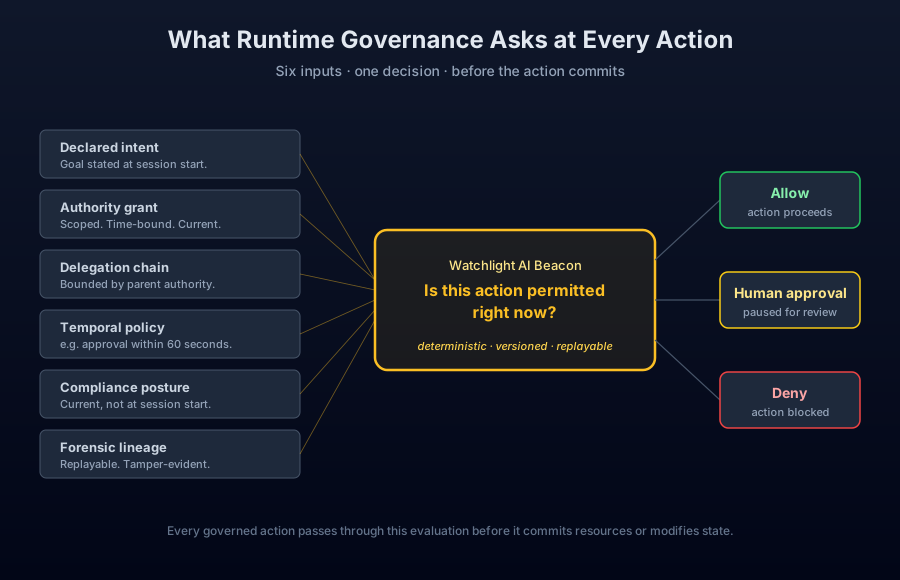
The runtime governance gap is the absence of a layer that answers, every time an autonomous agent attempts an action, the following questions:
- Is this action within the agent's declared intent for this session?
- Is the agent operating under a current, valid authority grant?
- If the action is delegated, is the delegation chain intact and bounded?
- Does the action satisfy temporal policy (such as "approval within 60 seconds for any vendor banking change")?
- Is the action consistent with the organization's compliance posture right now, not at session start?
- If the action proceeds and is later found to be wrong, can the decision be reconstructed from the event record?
No existing layer answers these. Identity is too coarse. Network is too late. AI security is too content-focused. The agent framework is the thing being governed, not the governor. A new layer is required.
What Agent Runtime Governance Actually Is
ARG is the discipline of governing autonomous AI agents at the moment of execution. Nine architectural primitives compose one decision: is this action permitted, right now?
Agent Runtime Governance is the discipline of governing autonomous AI agents at the moment of execution. It is not a product feature. It is a layer of operational infrastructure that sits between identity and the agent runtime.
ARG is built from a small number of architectural primitives:
- Agent identity. Every agent has a verifiable, durable identity distinct from the human or service that deployed it. Identity is the foundation; everything above it depends on it.
- Authority modeling. Authority is explicit, scoped, and time-bound. An agent does not inherit broad permissions from its deployer. It receives a specific grant for a specific purpose, valid for a specific window.
- Intent-aware authorization. Agents declare their purpose and current goal at session start. Authorization decisions consider whether a proposed action matches that declared intent.
- Delegation-chain validation. When an agent spawns a sub-agent, the sub-agent's authority is bounded by the parent's, with verifiable provenance back to the human or service that initiated the chain.
- Temporal policy enforcement. Some policies cannot be expressed as "is this action allowed?" They are temporal: "approval within 60 seconds," "no two large transfers within 24 hours from the same agent," "human review required for any action that touches both PII and external-network categories." ARG evaluates these constraints across time, not just per action.
- Scoped execution boundaries. What an agent can read, write, invoke, and delegate is constrained at the moment of execution, not just at registration time.
- Human-in-the-loop checkpoints. For certain action classes, the architecture pauses execution and routes the decision to a human. This is a property of the runtime, not an honor system inside the prompt.
- Forensic execution lineage. Every action, every policy decision, every delegation, and every escalation is recorded in a tamper-evident audit log structured for reconstruction by an auditor, a SOC analyst, or an opposing expert in a litigation discovery request.
- Runtime containment. When something is wrong, the runtime can contain the agent through graduated responses, from passive monitoring to full sandbox isolation, without depending on the agent's good behavior.
These primitives compose into a single answer to a single question: what is this autonomous system actually permitted to do, right now?
Allowing an agent to authenticate is not the same thing as allowing it to autonomously execute arbitrary actions.
ARG is the layer that closes that gap. The 12 Non-Negotiable Principles for Agent Runtime Governance describe each primitive in depth. Watchlight AI Beacon implements them in production.
AI Security vs Agent Runtime Governance
Both layers are necessary. Neither replaces the other. They operate at different points in the lifecycle of an AI-driven action.
The clearest way to see how these layers differ is side by side. Both are required. Neither replaces the other. They operate at different points in the lifecycle of an AI-driven action.
| AI Security | Agent Runtime Governance | |
|---|---|---|
| Primary focus | Content, prompts, models, outputs | Actions, authority, delegation, intent |
| Control boundary | The model and its inputs and outputs | The agent and what it does to enterprise systems |
| Enforcement timing | Inspection of content as it flows | Authorization of every action at the moment of execution |
| Runtime authorization | Limited to content and traffic policies | Continuous per-action authorization against current policy |
| Delegation governance | Generally out of scope | First-class; sub-agent authority bounded by parent |
| Intent evaluation | Detection of prompt anomalies | Authorization against the agent's declared intent and goal |
| Tool invocation governance | Filtering of tool inputs and outputs | Authorization of the invocation itself, before execution |
| Policy enforcement | Pattern matching, classification, signatures | Deterministic policy evaluation, versioned and current |
| Audit lineage | Logs of interactions and decisions | Tamper-evident reconstruction of every action and decision |
| Containment | Block, quarantine, or strip content | Graduated response from monitoring through sandbox isolation |
| Operational goal | Detect unsafe AI behavior | Govern what autonomous AI is permitted to do |
The comparison is not a competition. AI security is the right tool for AI security. ARG is the right tool for governing autonomous execution. Most enterprises will need both. The mistake is treating one as a substitute for the other.
Three Subcategories of AI Security
The AI Security layer itself splits into three architectural subcategories. Each is real, well-funded, and necessary. None is Agent Runtime Governance.
AI Posture Management. Discovers and inventories the AI agents an enterprise is running, attributes them to their creators, catalogs their tools and integrations, and surfaces configuration risk (overscoped grants, hardcoded secrets, unsafe integrations). The primary primitive is inventory. The operational mode is post-deployment scanning and continuous re-scanning.
AI Runtime Inspection. Watches an agent's execution path in real time, applies behavior-based pre-invocation checks, and intervenes when an action looks anomalous or matches a known unsafe pattern. The primary primitive is behavioral classification. The operational mode is inline interception driven by intent inference and anomaly detection.
Prompt and Model Security. Sits at the model boundary. It filters adversarial prompts, blocks jailbreaks, scans models for embedded risk, and applies content policies to inputs and outputs. The primary primitive is content inspection. The operational mode is pattern-based filtering in front of the model API.
Each subcategory produces real value, and most enterprises will run tools from at least one of them. None of these subcategories maintains an agent's authority grant, validates a delegation chain, evaluates temporal policy across time, or authorizes a specific action against current versioned policy. Those are the primitives of Agent Runtime Governance, and they sit one layer above.
Adjacent but Distinct
Three other categories are forming alongside ARG. Each solves a real but narrower problem. None is Agent Runtime Governance.
Agent identity and capability tokens. A growing set of vendors and standards (OAuth 2.1 extensions for agents, MCP, WIMSE) define how an agent's identity and granted capabilities flow through a request as a verifiable token. ARG uses such tokens as one of its inputs. The token answers "who is this agent and what could it theoretically do." ARG answers "what is this agent actually permitted to do right now, given its declared intent, delegation chain, temporal policy, and current compliance posture." Token issuance is necessary infrastructure; it is not a decision plane.
Agent runtime threat detection. Some vendors monitor agent reasoning, interactions, and execution to detect when an agent is being manipulated, misbehaving, or silently exfiltrating data. This is real value and a necessary part of defense in depth. But detection of risky behavior is not authorization of an action against current policy. A manipulated agent still passes detection if the manipulated action looks routine; an agent operating entirely within its declared intent still trips detection if a pattern-matcher flags the trace. ARG evaluates intent and authority. Threat detection evaluates behavior pattern. The two are parallel signals, not substitutes.
IAM extended to agents. Established IAM platforms are extending human-identity primitives to cover agent identity, bringing just-in-time access and compliance reporting to the agent fleet. The architectural challenge is that human-IAM primitives were designed for a different lifecycle. Humans don't declare plans, don't compose granted authorities at machine speed, don't delegate to sub-agents that carry their own claims, and don't produce execution lineage that crosses dozens of tool calls per minute. ARG primitives (declared intent, plan-act-observe lifecycle, delegation-chain validation, runtime containment) are agent-native. They don't translate from a human-IAM design stretched downward.
ARG sits above all three. It uses identity tokens as inputs, runs in parallel with threat detection, and operates on agent-native primitives rather than human-IAM primitives extended to agents.
Why This Becomes a New Infrastructure Layer
Every prior shift in enterprise computing produced its own runtime control plane. Autonomous AI is the next.
Every previous shift in enterprise computing produced its own runtime control plane.
- SaaS and cloud produced IAM. The question was "who can access what." The answer required a new layer because the question could no longer be answered at the network perimeter.
- Containers produced Kubernetes. The question was "what is running and how is it scheduled." The answer required a new layer because the question could no longer be answered by the host operating system.
- Endpoints produced EDR. The question was "what is the process actually doing." The answer required a new layer because the question could no longer be answered by signature-based antivirus.
- Cloud workloads produced CSPM and CNAPP. The question was "what is the posture and risk across thousands of dynamically provisioned resources." The answer required a new layer because the question could no longer be answered by spreadsheet inventories.
In every case, the new layer was not a feature of the layer below. It was a separate control plane with its own primitives, its own operational team, and its own integration points. And in every case, the previous-generation tools continued to exist alongside the new layer. EDR did not replace network security. Kubernetes did not replace identity. CNAPP did not replace endpoint protection. The layers stacked.
Autonomous AI is the next such shift. The question being asked, every minute, in production, by thousands of agents across an enterprise, is "is this autonomous system actually permitted to do this action right now?" That question cannot be answered by identity, by network, by the agent framework, or by AI security tools. It requires a new layer.
Agent Runtime Governance is that layer. It is operational infrastructure, not a feature.
Why Detection Alone Breaks Down
Detection works for humans because humans are slow. Autonomous agents are not.
There is a version of the argument that says "we will add governance signals to the detection stack." It is worth taking seriously and explaining why it is insufficient.
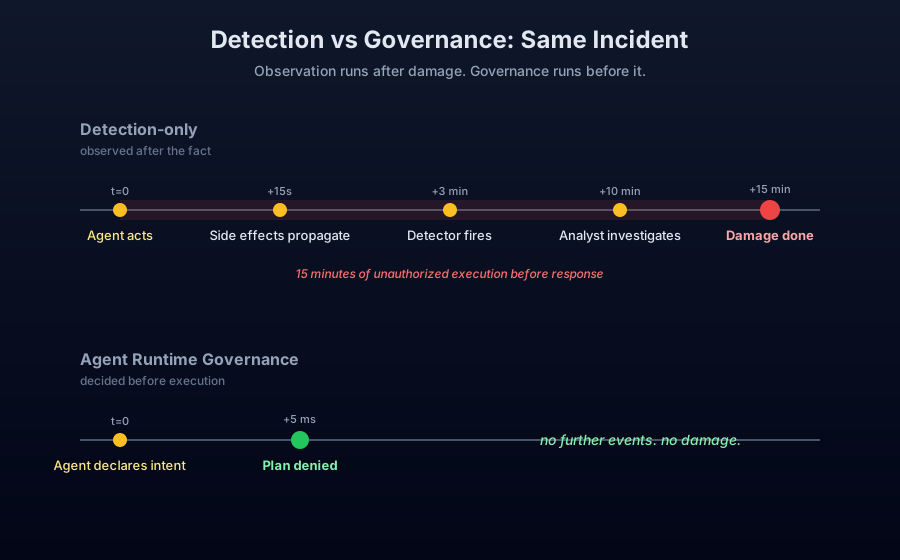
Detection observes. It looks at a stream of events and decides, after the fact, which were anomalous. For human-driven activity, detection works well. Humans operate slowly enough that an alert generated within minutes is actionable. The cost of waiting for confirmation is bounded.
Autonomous agents break that calculus in five places.
Speed. Agents can execute dozens of actions per minute. A detector that fires three minutes after a problem starts is already too late. By the time an analyst opens the ticket, the agent has already done its work.
Chained side effects. A single agent action often has downstream consequences that propagate through multiple systems before the next governance check. An invoice payment routes funds, generates GL entries, triggers vendor notification email, and creates downstream reconciliation records. Detection after the chain has executed is detection of damage, not detection of risk.
Delegated ambiguity. When an agent delegates to a sub-agent, which delegates to a tool, which calls an API, the question of "who is accountable" becomes murky in a detection-only model. Detection logs see the leaf action. Governance maintains the chain.
Forensic load. Reconstructing what happened across a multi-agent workflow is expensive when each layer kept its own logs in its own format. A control plane that captures the full lineage with tamper-evident integrity collapses days of forensic work into a single replay.
Unbounded blast radius. A human user with bad intent can do damage proportional to their authority and the time they have. An autonomous agent with bad intent can do damage proportional to its authority multiplied by machine speed multiplied by tool reach. The cost of detection-only is no longer bounded by human pace.
Detection observes behavior. Governance controls execution.
The future of enterprise AI is governed execution. Observed execution is the floor, not the ceiling.
The Watchlight AI Thesis
Watchlight AI Beacon answers the question that does not have a home in identity, in AI security, or in the agent framework itself: what is this autonomous system actually permitted to do, right now, given its intent, authority, delegation chain, and current policy? Every action by every governed agent passes through that question before the action commits resources or modifies state.
The architecture is deliberate.
- Authorization decisions are deterministic and replayable. The same inputs produce the same decision, every time. There is no language model in the trust path.
- Policy evaluation is versioned and current. The rules being enforced at this moment are the rules in effect at this moment, not the rules from session start.
- Delegation chains are first-class. An agent that spawns a sub-agent passes scoped authority down the chain with verifiable provenance. A delegated action carries its lineage with it.
- Audit evidence is tamper-evident. Every decision and every action is recorded with a cryptographic fingerprint, so the record an auditor sees is the record the runtime emitted.
Watchlight AI Beacon enforces at two layers by design.
The plugin sits inside the agent framework and applies governance at the semantic layer. It captures intent declaration, tool selection, and the framework's own lifecycle events. Watchlight AI Beacon evaluates each event against current policy and returns a decision in the moment, before the action commits.
The network proxy sits in front of the agent's outbound traffic and applies governance at the wire. Every HTTP request, regardless of which code path inside the agent produced it, must clear policy before reaching its destination.
The two layers catch different evasions. A plugin alone cannot govern an agent that bypasses framework instrumentation: a spawned subprocess, an unapproved HTTP library, a compromised third-party package. A proxy alone cannot reason about declared intent before a request reaches the wire. Run together, they enforce a fail-closed posture: if either layer is compromised or unavailable, the unauthorized action does not proceed.
Both layers integrate with the agent frameworks enterprises are actually deploying. See the plugin coverage matrix for current framework support.
That two-layer decision is the runtime governance control plane in operation. It is not a feature of a larger product. It is the layer.
Closing
Authentication is not authorization. Authorization at session-start is not governance at runtime. Detection observes behavior. Governance controls execution. Autonomous systems require operational control planes.
These are not slogans. They are the architectural premises of the next decade of enterprise AI. The enterprises that deploy autonomous agents successfully will be the ones that build out the runtime governance layer alongside their AI security investments, the way they built out IAM alongside network security a decade ago. The control plane is forming. The category is real. The question is whether your enterprise will recognize the layer in time to build it intentionally.
We're building Watchlight AI Beacon to be that layer.
For CISOs, security architects, and infrastructure leaders evaluating AI agent deployments: request a demo and we will run a structured runtime governance assessment against your existing agent fleet. We map your agents to authority class, identify where preflight authorization is currently reachable, and produce a private report. The engagement is one to two weeks; the report is yours regardless of outcome.
Request an assessment · See the platform · Read the framework: 12 Non-Negotiable Principles for Agent Runtime Governance
Subscribe to Watchlight Insights
Get new writing on Agent Runtime Governance, AI agent security, agent identity, and delegated authorization, delivered when we publish. No noise, just the new posts.
Unsubscribe anytime. We never share your email.
Put runtime governance in front of every agent action
Watchlight AI Beacon is available now, fully on-premises and air-gapped. Request a demo to see it in your environment.
Agent Governance Readiness Assessment
Evaluate your governance posture against the 12 principles. Get a maturity score and roadmap.
2-3 days · Download one-pager (PDF)