
Before Agent Runtime Governance vs After: The Missing Control Plane for AI Agents
The Shift from AI Assistants to AI Agents
Organizations are rapidly moving from chatbots and AI assistants to autonomous AI agents. The difference is fundamental. An assistant generates answers. An agent takes actions.
Today's AI agents can call APIs, access SaaS systems, execute multi-step workflows, and interact with other agents. They read customer records, modify CRM entries, query databases, send emails, provision infrastructure, and issue refunds. They do this autonomously, at machine speed, across enterprise systems.
This shift introduces a new operational reality: AI systems are no longer just generating text. They are performing actions that have real consequences for customers, operations, and compliance.
Security leaders are beginning to ask a question that their current infrastructure cannot answer:
"Who authorized the AI to do that?"
How AI Agents Work
The typical modern agent architecture follows a straightforward flow:

A user makes a request. The LLM reasons about what to do. The agent framework orchestrates tool calls. The tools perform actions against enterprise systems.
The critical detail: the model decides what to do, but the tools are what actually perform the actions. The model operates inside a reasoning layer that is invisible to traditional enterprise security controls. It selects tools, determines parameters, and sequences actions based on its own planning. Enterprise governance policies do not participate in this decision process.
The "Before ARG" World
Organizations are currently trying to secure AI agents using the controls they already have.
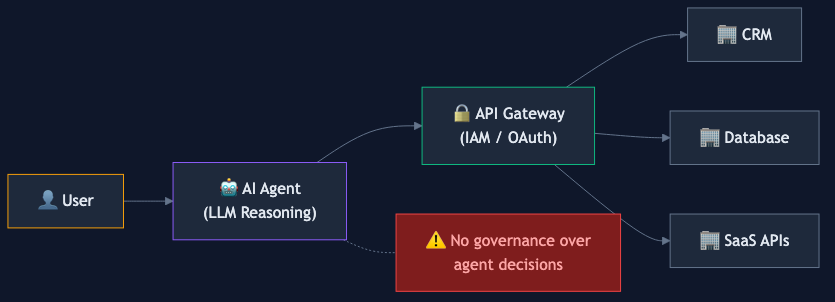
The typical approach uses familiar security controls: IAM and OAuth scopes for authentication, API gateways for rate limiting and access control, RBAC and service accounts for permission management, network policies for segmentation, and audit logs for after-the-fact review.
These controls are valuable. They remain essential. But they share a critical limitation: they govern access to systems. They do not govern the decisions agents make.
Consider an AI agent in a customer support workflow. The agent has valid credentials. Its OAuth scopes allow it to read customer records, modify CRM entries, and issue refunds. Every API call passes authentication. Every permission check succeeds.
But the agent just issued a $500 refund to a customer who made a minor complaint. The refund was technically permitted by the agent's credentials. It was not permitted by the company's refund policy, which caps automatic refunds at $50 and requires manager approval above that threshold.
The API gateway saw a valid request. The IAM system saw a valid identity. Neither saw a policy violation. The violation happened in the agent's reasoning layer, which no traditional security control evaluates.
Why Traditional IAM Breaks with AI Agents
IAM was designed for a specific model of computing:
Human → Request → Resource
A human user authenticates, makes a request, and accesses a resource. IAM evaluates the user's identity and permissions at the time of the request. This model has served enterprises well for decades.
AI agents introduce a fundamentally different pattern:
Context → Reasoning → Action

The agent accumulates context from its environment. It reasons about what to do based on that context, its goals, and the tools available to it. It takes action based on its own planning.
The reasoning step happens inside the model. It is invisible to traditional access control. IAM evaluates identity and permissions. It does not evaluate whether the agent's reasoning produced an appropriate action given the current business context, the declared intent, the delegation chain, or the applicable governance policies.
This creates a governance gap. We call it the AI decision layer: the space between "the agent has access" and "the agent should take this action right now."
The Missing Layer: Agent Runtime Governance
Agent Runtime Governance (ARG) is a control plane designed specifically for AI-driven systems. It sits between the agent and the enterprise systems the agent attempts to interact with.
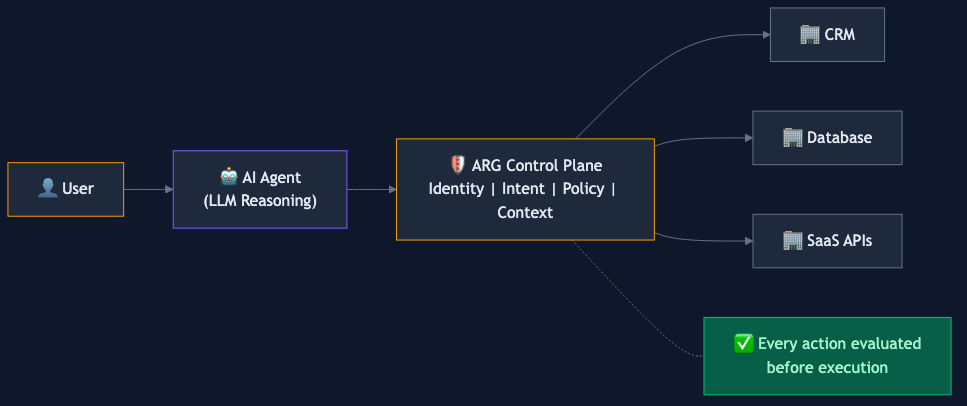
Instead of trusting the agent's decision and only validating its identity, ARG evaluates the action itself. On every request, ARG assesses:
- Agent identity: Who is this agent, and who owns it?
- Declared intent: What is the agent trying to accomplish, and why?
- Runtime context: What is the agent's current lifecycle phase, authority grant, and delegation chain?
- Requested action: What specific action is the agent attempting to perform?
- Applicable policies: Does this action comply with the organization's governance policies?
The system does not trust the agent's reasoning. It verifies the agent's action against enterprise policy before the action executes.
What Changes After ARG
The operational posture shifts from static permissions to runtime decision control.
Before ARG: Agents can execute actions based on internal reasoning with limited oversight. If the credentials are valid, the action proceeds.
After ARG: Every agent action is evaluated against enterprise policy before execution. Credentials are necessary but no longer sufficient.
The capabilities that ARG introduces:
- Runtime authorization for every agent action, evaluated at the moment of execution
- Policy evaluation based on intent, context, delegation chain, and business rules
- Credential mediation: agents never hold raw secrets; the governance layer injects credentials on their behalf
- Immutable audit trails with full governance context: who, what, why, under what authority, and which policy decided
- Human-in-the-loop checkpoints for high-risk operations, triggered automatically by policy
- Execution lineage: reconstruct the full chain from human authorization through every delegation hop to the downstream resource
Governance moves from "can the agent access this system" to "should the agent perform this specific action right now."
Example: Refund Agent in a Customer Support System
Consider a concrete enterprise scenario.
Before ARG
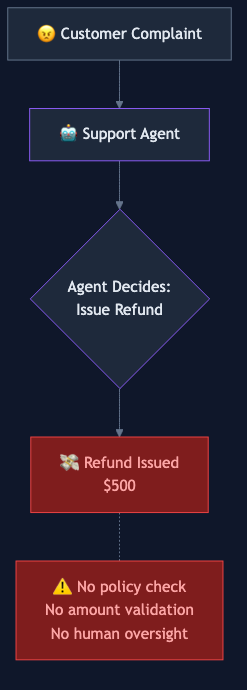
An AI support agent receives a customer complaint. The agent's reasoning determines that a refund is appropriate. The agent issues a $500 refund. No policy check on the amount. No validation against the customer's history. No human approval. The refund executes because the agent has the technical permission to do it.
The risks are real: excessive refunds, policy violations, financial abuse, and no audit trail that explains why the agent decided to issue this specific amount to this specific customer.
After ARG
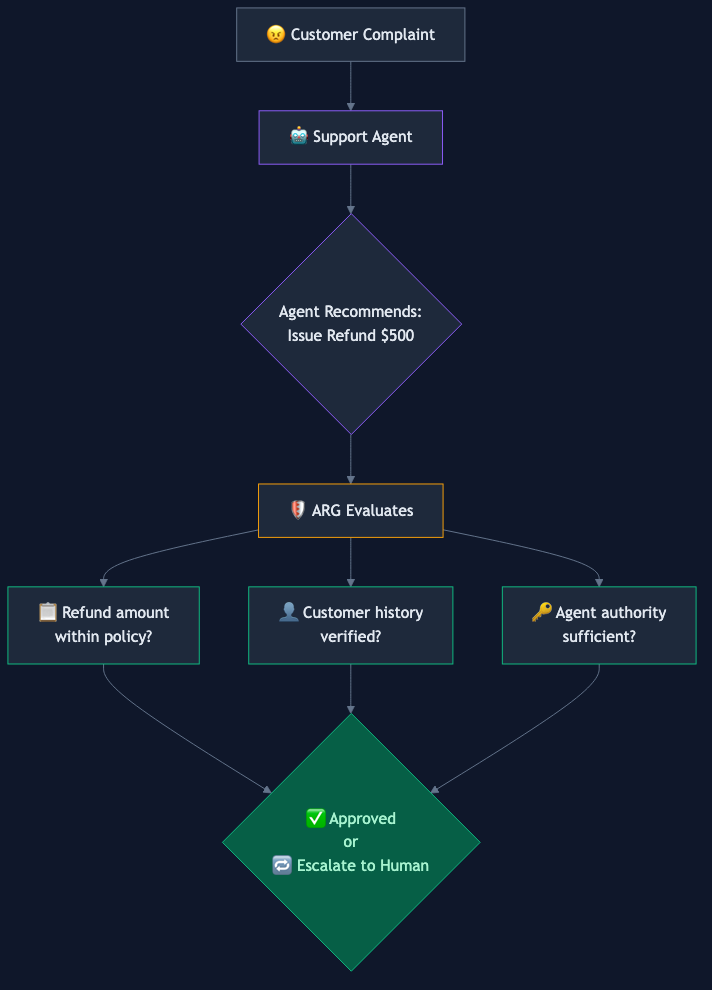
The same agent receives the same complaint. The agent recommends a $500 refund. Before the refund executes, the ARG control plane evaluates the action:
- Refund amount: $500 exceeds the $50 automatic threshold. Escalation required.
- Customer history: Customer has three prior refunds in the last 30 days. Flag for review.
- Agent authority: Agent's current authority grant permits refunds up to $50. This action exceeds scope.
- Company policy: Refunds above $50 require manager approval per policy v2.1.
The agent recommended the action. Governance decided whether it executed. The refund is escalated to a human reviewer with full context. The decision is recorded in the audit trail.
Why This Matters for CISOs and CIOs
Without runtime governance, organizations face a growing set of operational risks:
- No explainability: When an AI action causes harm, there is no record of why the agent made that decision or what authorized it.
- Limited auditability: Audit logs show that an API was called. They do not show whether the call was appropriate given the agent's purpose, authority, and the policies in effect.
- Compliance exposure: Regulators expect demonstrable controls over systems that make autonomous decisions affecting customers and operations. "The AI decided to do it" is not an acceptable compliance response.
- Reactive risk management: Without runtime evaluation, organizations discover problems after the damage is done. The $500 refund is already issued. The data is already accessed. The email is already sent.
With Agent Runtime Governance:
- Every agent action has verifiable, auditable authorization.
- Decision context is recorded: who authorized it, what intent was declared, which policy was evaluated, and what the result was.
- High-risk actions are caught and escalated before execution.
- Organizations gain operational trust in autonomous systems because they can prove how those systems are governed.
The Emerging Control Plane for Agentic AI
As AI agents become more capable, runtime governance will become a foundational infrastructure layer. This follows a pattern the industry has seen before.
Identity for cloud access. When organizations moved to the cloud, identity became the control plane for managing who could access what across distributed systems.
API gateways for microservices. When monoliths broke into microservices, API gateways became the control plane for managing traffic, authentication, and rate limiting across service boundaries.
Runtime governance for AI agents. As autonomous agents enter enterprise systems, Agent Runtime Governance becomes the control plane for managing what agents can do, under what authority, and with what accountability.
Each transition required new infrastructure because the existing controls were designed for a different operational model. IAM was not designed for microservices. API gateways were not designed for autonomous agents. The pattern is consistent: new operational models require new control planes.
The Question Every Enterprise Will Ask
Every enterprise deploying AI agents in production will eventually face the same question:
"Who authorized the AI to do that?"
Agent Runtime Governance provides the answer. Not just who the agent is, but what it was trying to do, under what authority, within what delegation chain, evaluated against which policies, and whether a human approved it.
As organizations move from experimentation to production AI agents, governance must evolve alongside autonomy. The future of enterprise AI depends not only on what agents can do, but on how their actions are governed.
The infrastructure to govern autonomous AI agents must emerge before large-scale agent adoption, not after the first incident.
Agent Runtime Governance is the architectural layer between identity systems and agent frameworks. Watchlight AI Beacon is the enterprise control plane that provides agent discovery, runtime governance, policy enforcement, delegation tracking, and execution lineage. To learn more, read the 12 Non-Negotiable Principles or request a demo to see Beacon govern your own agents.
Subscribe to Watchlight Insights
Get new writing on Agent Runtime Governance, AI agent security, agent identity, and delegated authorization, delivered when we publish. No noise, just the new posts.
Unsubscribe anytime. We never share your email.
Put runtime governance in front of every agent action
Watchlight AI Beacon is available now, fully on-premises and air-gapped. Request a demo to see it in your environment.
Agent Governance Readiness Assessment
Evaluate your governance posture against the 12 principles. Get a maturity score and roadmap.
2-3 days · Download one-pager (PDF)