
Endpoint Detection: Why EDR Alone Cannot Govern AI Agents at Runtime
Understanding the difference between detecting AI behavior and governing AI authority.
The Rise of Autonomous Software
AI systems are evolving from passive tools into agents that take real actions on enterprise systems. They execute shell commands, modify files, access APIs, trigger CI/CD pipelines, interact with SaaS systems, and orchestrate other agents. The work that used to require a human keyboard now happens at machine speed, often without a human in the loop for individual actions.
This changes the security model.
Traditional security tools were designed for human users running static applications with predictable behavior. AI agents introduce autonomous decision-making into software execution. The agent reasons about what to do, selects the tools available to it, and takes action based on its own planning.
This raises a question that the existing security stack was not designed to answer:
Who authorized the AI agent to do that?
What Endpoint Detection and Response Does Well
Endpoint Detection and Response (EDR) is a mature category of security tooling focused on observability and detection at the operating system level. It is essential infrastructure in any modern enterprise security program, and it remains essential as AI agents enter production environments.
EDR provides deep runtime visibility into what is happening on a system:
- Process monitoring and process tree reconstruction
- Command execution tracking
- File access and modification monitoring
- Network connection inspection
- Behavioral anomaly detection
- Endpoint isolation and containment
When an AI coding agent executes a shell command, EDR sees the full chain: the IDE that launched the agent process, the shell command the agent invoked, the git push operation, the network connection to the CI/CD system, and any files that were modified along the way. EDR captures the process tree, the file system activity, and the system calls. Security teams gain a forensic record of what actually happened on the endpoint.
This visibility is foundational. Any security architecture that includes AI agents will rely on EDR to understand what those agents do once they start executing.
The Limitation of Detection
EDR is excellent at answering one critical question: what happened?
It is not designed to answer the questions that come before execution:
- Was the action authorized?
- What policy permitted it?
- Which agent requested the action, and on whose behalf?
- What task required this specific operation?
- What scope of authority was granted, and is it still valid?
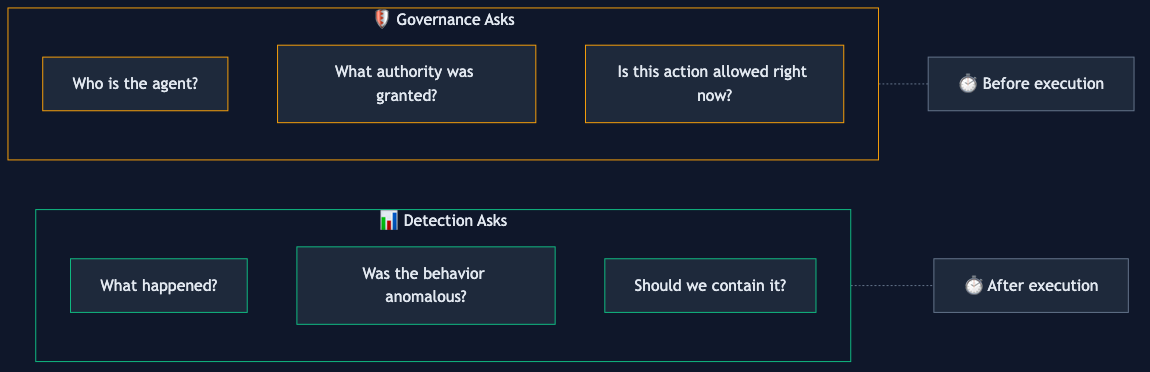
Consider an AI agent that pushes code to a production environment. EDR can detect the git push command, capture the network activity, and reconstruct the process tree that led to the push. But it cannot determine whether the agent had permission to push to production, whether the action matched the agent's intended task, whether the authority granted to the agent had expired, or whether the deployment policy required human approval.
By the time EDR sees the action, execution is already underway. Detection happens after the fact, by design. That is the model EDR was built on, and it is the right model for the layer it operates at.
The gap is not in what EDR does. The gap is in what a different layer needs to do.
The Missing Layer: Agent Runtime Governance
Agent Runtime Governance is the control plane that authorizes and governs agent behavior before execution occurs. It sits between identity systems and the runtime environment, and it answers a different set of questions than EDR:
- Who is the agent, and what is its verified identity?
- What task is it currently performing?
- What authority has been granted for this task?
- What tools and resources may it access?
- What data may it use?
- How long is the authority valid?
These questions cannot be answered after the fact. They must be answered at the moment the agent attempts an action, by infrastructure that has visibility into the agent's identity, declared intent, current authority grant, and the policies that govern its behavior.
The AI Security Stack
When you put these pieces together, a layered model emerges. Each layer answers a different question, and each layer is necessary.
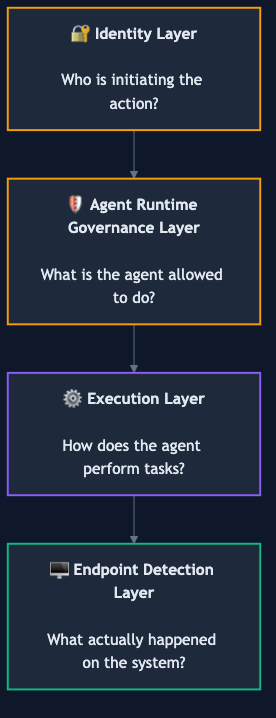
Identity Layer. Who is initiating the action? This layer authenticates users, services, and agents. It establishes verified identities and manages credentials. Standards like OIDC, SPIFFE/SPIRE, and SCIM operate here.
Agent Runtime Governance Layer. What is the agent allowed to do right now? This layer evaluates every agent action against declared intent, scoped authority, and runtime policy. It mediates credentials, validates delegation chains, and produces the audit record that answers "who authorized this?"
Execution Layer. How does the agent perform its tasks? This is where the agent framework, the LLM, the tool integrations, and the orchestration logic operate. The agent reasons about what to do and invokes tools to do it.
Endpoint Detection Layer. What actually happened on the system? This is where EDR observes process activity, file changes, network connections, and behavioral patterns. It produces the forensic record of execution.
All four layers are necessary. None of them can substitute for another. Identity without runtime governance produces unbounded agents. Runtime governance without endpoint detection produces ungoverned host activity. Endpoint detection without runtime governance produces forensic logs that cannot answer the most important questions about agent behavior.
Example: Governing an AI Coding Agent
Consider a concrete scenario. A developer asks an AI coding agent to fix a failing test suite and deploy the patch to staging.
The agent performs multiple actions: it reads the repository, modifies source files, runs tests, commits changes, pushes to the CI/CD pipeline, and deploys to staging.
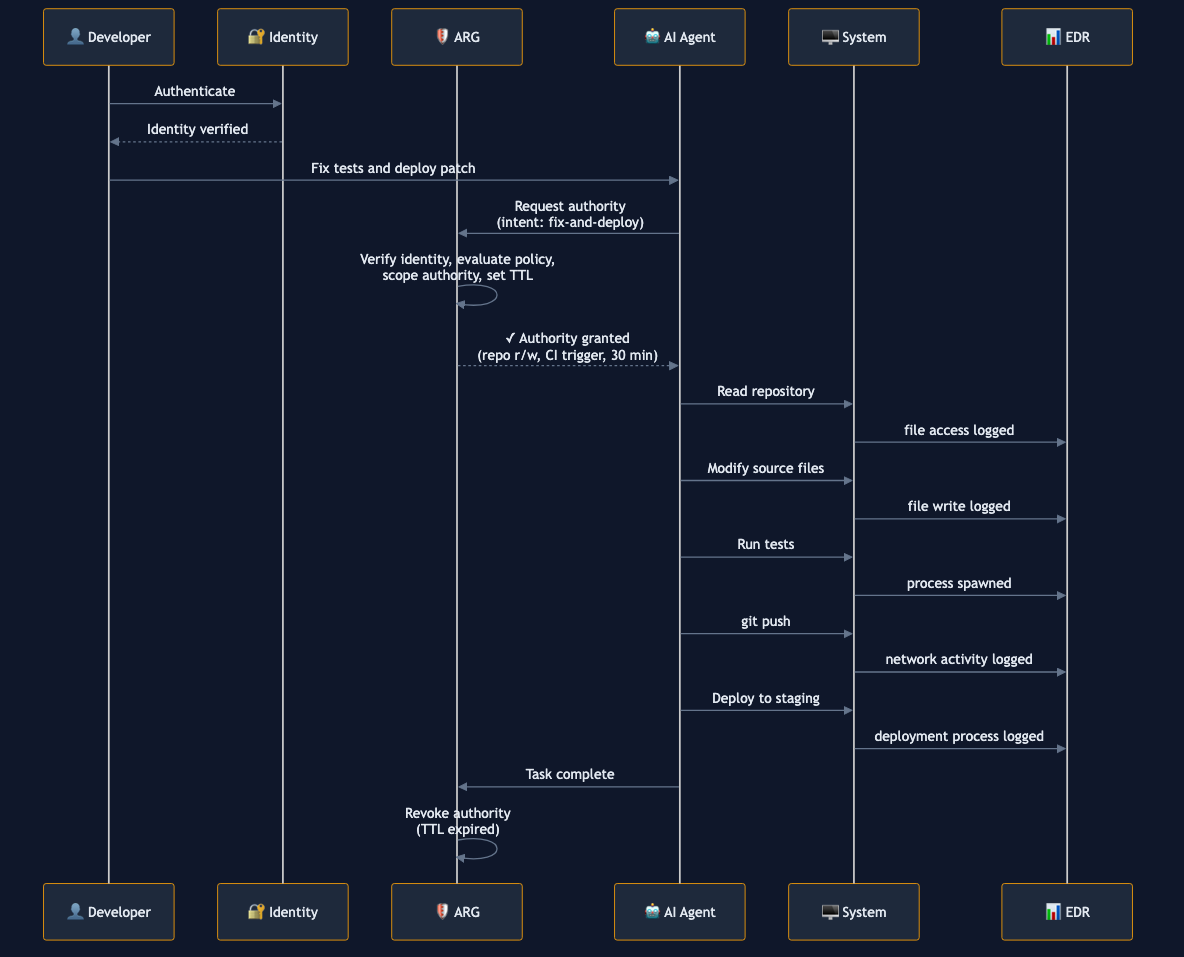
Here is how each layer contributes:
Identity Layer. The developer authenticates through the identity provider. The developer's identity is verified before any agent action begins.
Agent Runtime Governance Layer. The agent's identity is registered. The intent is declared: "fix failing tests and deploy patch." The authority granted is scoped to repository read/write, CI trigger permission, and staging deployment for a 30-minute window. The authority is bound to this specific task and expires automatically when the task completes or the time limit elapses.
Execution Layer. The agent performs the actions: reads files, makes changes, runs tests, commits, pushes, and deploys. Each tool invocation passes through the runtime governance layer for evaluation. If the agent attempts an action outside its scoped authority, the action is denied before execution.
Endpoint Detection Layer. EDR observes the runtime behavior: process spawns, file modifications, network connections to the CI system, deployment process activity. It captures the forensic record of what actually happened on the host.
If a security incident occurs, the four layers together produce a complete picture: who started the task (identity), what authority was granted (governance), what the agent attempted to do (execution), and what actually executed on the system (detection).
Detection and Governance Are Not Substitutes
It is worth being explicit about how these layers relate.
Detection systems react to behavior. They observe what is happening, identify anomalies, and respond after the fact. This is the right model for endpoint security.
Runtime governance systems define and enforce allowed behavior. They evaluate authority before execution, mediate credentials, and produce a record of why an action was permitted. This is the right model for autonomous agents.
Detection asks "what happened?" Governance asks "what should be allowed to happen?" Both are necessary. Neither can answer the other's question.
Without runtime governance, AI agents operate with whatever credentials and permissions they were configured with at deployment. Their authority has no temporal boundaries, no intent validation, and no real-time policy enforcement. Detection becomes the primary control, which means the organization is reacting to events after they have already taken effect.
Without endpoint detection, the organization has no visibility into what the agent's actions actually did once they reached the operating system. Governance answers "the agent was allowed to write to /tmp/build." Detection answers "the agent wrote a 4GB file containing this specific content and triggered these downstream processes."
The Role of Watchlight AI
Watchlight AI Beacon is an enterprise control plane designed to implement the runtime governance layer for AI agents. It provides:
- Agent identity registry with continuous discovery and trust state management
- Policy decision point for evaluating every agent action against intent, authority, and policy
- Delegated authority management with cryptographic delegation chains and scope narrowing
- Credential brokering so agents never hold raw secrets
- Execution lineage tracking with the Agent Execution Graph
- Runtime policy enforcement at the moment of every action
- MCP server governance and tool registry
These capabilities allow organizations to answer the question that EDR is not designed to answer: who authorized the AI agent to perform this specific action right now?
Watchlight AI Beacon does not replace EDR. It complements it. EDR continues to do what it does well at the endpoint layer. Watchlight AI Beacon provides the governance layer that answers the questions EDR cannot.
The Future of AI Security Architecture
Securing autonomous systems requires multiple control points working together. Future enterprise architectures will include identity for agents, runtime governance for agent authority, policy enforcement at the moment of every action, execution monitoring through agent observability, and behavioral detection through endpoint security.
This is not new infrastructure replacing old infrastructure. It is new infrastructure that fits into the existing stack and answers questions the existing stack cannot.
Just as IAM became necessary infrastructure when human users moved beyond a single mainframe, runtime governance will become necessary infrastructure as AI agents move beyond single workflows. The core security question evolves from "who logged in?" to "who authorized the AI agent to take that action?"
The organizations that answer this question early will be the ones that can adopt AI agents at scale with confidence. The ones that wait will discover, eventually, that detection alone was not enough.
Agent Runtime Governance is the architectural layer between identity systems and agent execution environments. Watchlight AI Beacon is the enterprise control plane that implements this layer. To learn more, read the 12 Non-Negotiable Principles or request a demo to see Beacon govern your own agents.
Subscribe to Watchlight Insights
Get new writing on Agent Runtime Governance, AI agent security, agent identity, and delegated authorization, delivered when we publish. No noise, just the new posts.
Unsubscribe anytime. We never share your email.
Put runtime governance in front of every agent action
Watchlight AI Beacon is available now, fully on-premises and air-gapped. Request a demo to see it in your environment.
Agent Governance Readiness Assessment
Evaluate your governance posture against the 12 principles. Get a maturity score and roadmap.
2-3 days · Download one-pager (PDF)