
Securing the Agentic Loop: Governing Autonomous AI at Runtime
Authorization and Runtime Control Architecture
Design governance for the agentic loop alongside your existing IAM and PAM stack.
Strip away the branding and every long running autonomous AI agent is the same thing: a loop. It reads an objective, decides on an action, takes it, looks at the result, and uses that result to decide the next action. Reason, act, observe, and repeat, until the objective is met or the agent gives up. That loop is the entire reason agents are valuable. It is also the entire reason they are risky, and it is the one thing traditional security was never designed to govern.
The distinction matters for anyone accountable for this technology, in the boardroom and in the architecture review alike. A single call to a model is a transaction. You can inspect it, rate-limit it, and log it. An agentic loop is not a transaction. It is a small autonomous process that makes its own decisions, many times in a row, faster than a person can follow, with each decision built on the last. Securing the model that sits inside the loop does not secure the loop. That gap is where Agent Runtime Governance begins.
The loop breaks the assumptions security was built on
Enterprise security has spent decades getting good at guarding entry points. The agentic loop does not have one entry point. It has a new decision every few seconds, and each assumption underneath our existing controls quietly fails.
Authenticate once, decide thousands of times. Identity and access management establishes who the agent is at the start of the run. The loop then makes hundreds of decisions that nobody re-checked. Knowing the agent's identity tells you nothing about whether its next action, chosen on its own in reaction to something it just read, should be allowed.
Detect after the fact, act right now. Detection and monitoring report what already happened. In the time it takes an alert to fire, the loop has already run its next several steps. Against a process that operates at machine speed, an after-the-fact signal is a record of the damage rather than a control on it.
The loop's inputs are untrusted, and they steer it. This is the one that matters most. Everything the loop reads back, a tool result, a retrieved document, a web page, another agent's output, flows straight into its next decision. A poisoned input is not a data-quality problem. It becomes the loop's next instruction. A support agent that reads a ticket containing hidden text telling it to export the customer list does not see an attack. It sees its next task. This is indirect prompt injection, and the loop is the delivery mechanism.
Small deviations compound. A loop that drifts one step off course does not stop. It keeps going, at machine speed, each step building on the last, so a minor deviation early becomes a consequential action later in the same run.
Loops multiply. A loop can call sub-agents, hand work to other loops, and start new processes. One loop you thought you understood becomes several you never see, each making its own decisions with authority it picked up along the way.
Put together, the agentic loop is an autonomous, fast, steerable process acting against your production systems. Governing the model inside it does not govern any of that.
The three points in the loop that have to be governed
An agent's loop moves through three stages on every pass: it plans, it acts, and it observes. Each is a place a decision gets made, and a loop is only as governed as its weakest one.
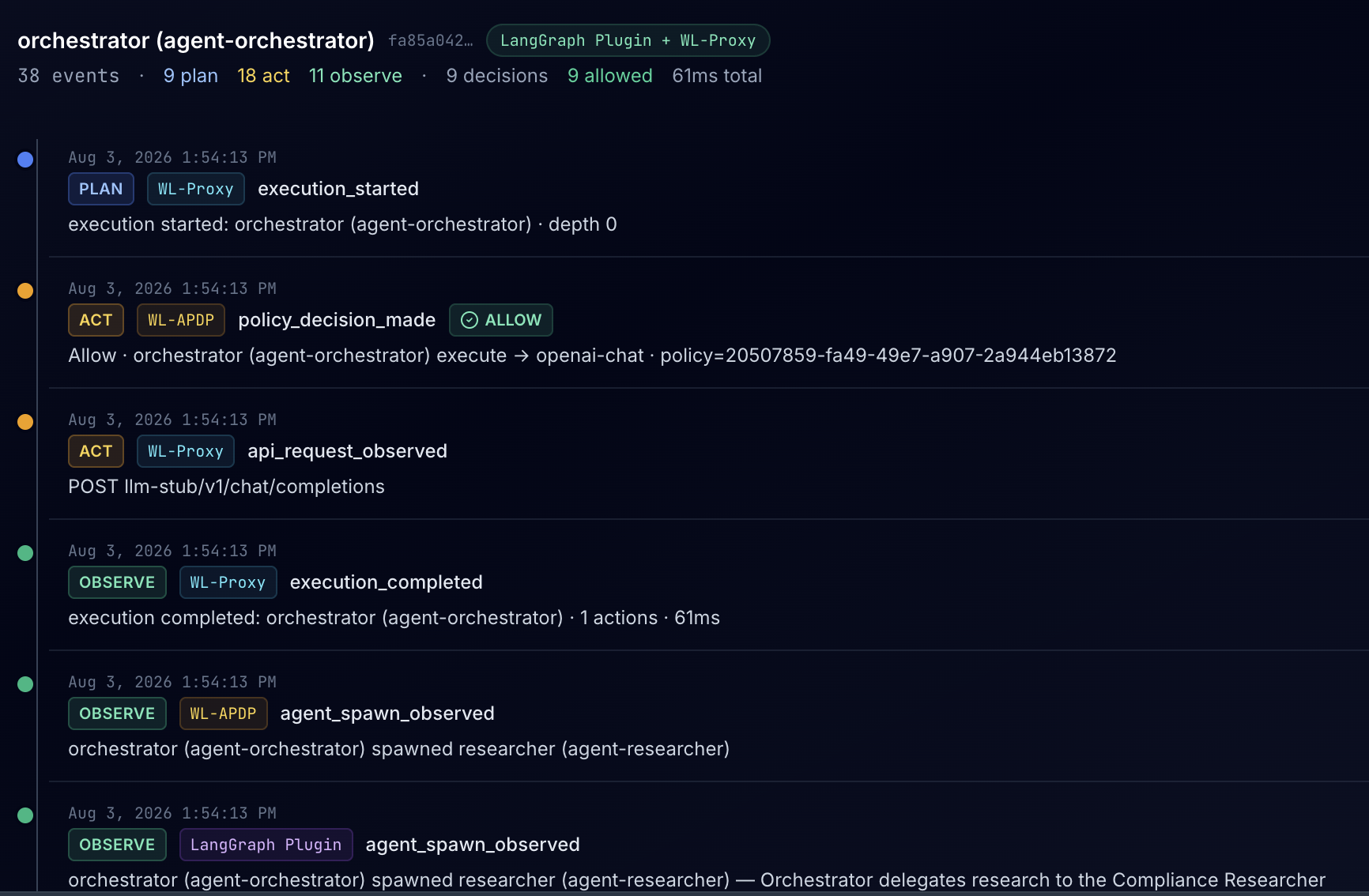
An agent run in Watchlight AI Beacon, seen as its plan, act, and observe events. Every action is evaluated at the moment it happens, and the whole run is recorded as execution lineage. Click the image to expand.
Before the loop commits: the plan. The most consequential decision an agent makes is its first one. Before the loop starts spending time, money, and authority, its intent should be evaluated against policy, so an objective that is out of scope can be stopped before a single action runs.
Inside every pass: the action. Every tool call and every outbound request, on every iteration, has to be evaluated against current policy and the authority the agent actually holds for this task. The loop deciding to do something is not the same as the loop being allowed to. The thing you govern is the action, at the moment it happens, not the identity the agent presented an hour earlier.
When the loop observes: the reaction. This is the stage most controls ignore. Because what the loop reads becomes what it does next, the safe assumption is that any input can be hostile. The control that matters is on the loop's reaction: the next action it takes after reading something has to clear policy before it runs. An agent that was asked to summarize a ticket and now wants to export a database has done something its task never called for, and that is the moment to stop it, whatever the ticket said.
Around these three points sits the loop as a whole. Governing it also means bounding how far it can reach, catching a chain of individually-allowed actions that together cross a line, and applying the same controls to every sub-loop it spawns.
What it takes to govern the loop at runtime
Watchlight AI Beacon is the enterprise control plane for Agent Runtime Governance, and securing the loop is precisely what it is built to do. It closes the gaps above on every pass of the loop, through a set of capabilities that work together.
Enforcement at two layers. Governance sits at both places the loop can be caught. An in-process plugin works inside the agent framework, at the plan and act stages, so an action can be stopped before it runs. The enforcement proxy governs every outbound request on the wire, whatever produced it, so an action that steps outside the framework, through a spawned process, a different network path, or a compromised dependency, still has to clear policy. The two layers enforce the same policy and catch different kinds of evasion. An unauthorized action has to get past both.
Every action evaluated against current policy, on every pass. Each action the loop attempts is checked against current, versioned policy at the moment it happens. The evaluation is deterministic, with no language model sitting in the trust path, so the same situation produces the same decision every time. The loop cannot talk its way past a control that is not another model to be persuaded.
Authorization tied to intent and authority, so drift and hijack are caught. Actions are evaluated against what the agent was actually authorized to do for its current task. An action that a poisoned input tries to induce, one the agent holds no authority for, does not proceed simply because the agent decided to take it. This is how the observe stage stops being a blind spot.
No standing privilege inside the loop. Authority is scoped to the task and does not persist between tasks, so the loop cannot accumulate access as it runs, and a sub-loop never holds more than it was given. This is the difference between a compromised loop reaching one system and a compromised loop reaching everything. It is the heart of two of the gaps agents create most often: zero standing privileges and agent-to-agent delegation.
A human in the loop at the moments that matter. When an action crosses a risk threshold your policy defines, the loop pauses for a person before it proceeds. That restores judgment exactly where autonomy removed it, without asking anyone to watch every pass of every loop.
Governance across the whole run, not just single steps. Some damage is done by a series of actions that are each individually permitted. Beacon evaluates the run as a whole, so a sequence that together moves money or moves data off-limits is caught even when no single step looks wrong on its own.
A provable record of the entire loop. Every action, decision, and grant of authority is recorded as tamper-evident execution lineage you can query. When someone asks how an agent reached a particular action, the answer is a chain you can reconstruct, from the human who started the work to the resource it touched, rather than an inference from scattered logs.
Fail closed. If an action cannot be authorized, it does not run. A governance layer that is unavailable degrades the loop to stopped, never to unbounded. Safe failure is built into the design.
The payoff
Autonomous agents usually stall between an impressive pilot and a production deployment for one reason, and it is rarely the model. It is that no one can say, with confidence, what the loop will do several steps in when it reads something unexpected. Governing the loop at runtime makes that answer knowable. Every action checked against current policy and real authority, every input treated as untrusted, the whole run recorded, and the system failing closed when something is wrong.
That is what it takes to put agentic loops into production with the same confidence your organization already demands of the systems people operate by hand. The loop is where agents act. Governing the loop, at runtime, on every pass, is the work Agent Runtime Governance exists to do.
If your team is putting autonomous agents into production and wants to compare notes on governing the loop, we would welcome the conversation. Watchlight AI Beacon puts these patterns into practice today. Request a demo to see it against your own agents.
Designing governance for the agentic loop? Our Agent Authorization & Runtime Control Architecture engagement helps enterprise teams design intent declaration, per-action authorization, delegation control, and runtime enforcement that fits alongside their existing IAM and PAM stack. Book a workshop.
Subscribe to Watchlight Insights
Get new writing on Agent Runtime Governance, AI agent security, agent identity, and delegated authorization, delivered when we publish. No noise, just the new posts.
Unsubscribe anytime. We never share your email.
Put runtime governance in front of every agent action
Watchlight AI Beacon is available now, fully on-premises and air-gapped. Request a demo to see it in your environment.
Agent Governance Readiness Assessment
Evaluate your governance posture against the 12 principles. Get a maturity score and roadmap.
2-3 days · Download one-pager (PDF)