
Verifiable Credentials and Agent Runtime Governance: Cryptographic Trust for Autonomous Systems
Authorization and Runtime Control Architecture
Design agent identity, delegation chains, and cryptographic trust for your agent infrastructure.
When an AI agent presents itself to a downstream system, a peer agent, or a governance checkpoint, three questions determine whether the interaction should proceed:
- Is this agent who it claims to be?
- Does it have the authority it claims to have?
- Does it meet the governance requirements the verifier expects?
Today, most enterprises answer these questions with OAuth tokens, service accounts, and API keys. These mechanisms are foundational and will remain so. But they share a structural limitation: they require real-time contact with the authorization server to verify, they expose all claims or none, and they do not carry rich governance context like delegation chains, compliance attestations, or intent declarations.
W3C Verifiable Credentials offer a different model. One that is cryptographic, portable across trust boundaries, privacy-preserving through selective disclosure, and verifiable without contacting the issuer at the time of verification. This post explores how VCs could apply to Agent Runtime Governance as AI agents begin to cross organizational boundaries. The industry has not yet converged on a single approach. We offer this as one perspective on the art of the possible, grounded in standards that are mature and architectural patterns we are actively exploring.
What Verifiable Credentials Are
The W3C Verifiable Credentials Data Model v2.0 (a W3C Recommendation since May 2025) defines a standard for tamper-evident credentials. A credential is a set of one or more claims made by an issuer about a subject. A verifiable credential adds a cryptographic securing mechanism that makes the credential's authorship and integrity provable. The companion specification Securing Verifiable Credentials using JOSE and COSE (also a W3C Recommendation) defines how credentials are secured using established signing mechanisms: JWS for JSON-based credentials, SD-JWT for selective disclosure within the JWT ecosystem, and COSE for compact binary representations suited to constrained environments. The model has three roles:
Issuer. An entity that creates a credential, signs it cryptographically, and issues it to a holder. The issuer asserts that specific claims about a subject are true. In agent governance, the issuer is typically a governance authority, a compliance auditor, or a service registry.
Holder. An entity that receives and stores credentials. The holder decides when and how to present credentials to verifiers, packaging them into verifiable presentations: tamper-evident envelopes that prove the holder's control over the credentials being presented. In agent governance, the holder is the AI agent itself. The agent carries credentials that attest to its identity, authority, compliance status, and other governance properties.
Verifier. An entity that receives a verifiable presentation and validates it. The verifier checks the cryptographic signatures against the issuer's public key, evaluates the claims against its own policies, and makes a trust decision. Critically, the verifier is responsible for determining whether the claims are sufficient for its needs. In agent governance, the verifier is the policy engine, a peer agent, or a downstream system.
The properties that make VCs architecturally significant for agent governance:
Offline verification. The verifier checks the issuer's signature locally using the issuer's public key. No real-time call to the issuer is required. This eliminates the authorization server as a single point of failure and prevents the issuer from learning when and where credentials are verified.
Selective disclosure. Using cryptographic schemes like BBS signatures, a holder can present a proof that reveals only specific claims from a credential without exposing the rest. An agent can prove it has a specific capability without revealing its full capability set.
Portability. A credential issued by one authority can be verified by any party that trusts the issuer's public key. No bilateral integration or federation metadata exchange is required.
Revocation. The W3C Bitstring Status List provides a privacy-preserving revocation mechanism. Verifiers check a published bitstring to determine if a credential has been revoked, without contacting the issuer or revealing which specific credential they are checking.
Why This Matters for Agent Governance
The limitations of current token-based trust become apparent as agent systems grow in complexity.
OAuth tokens require real-time issuer availability. Every token verification is a round trip to the authorization server. For a fleet of agents making thousands of decisions per hour across distributed systems, the authorization server becomes both a bottleneck and a single point of failure. If the server is down, agent operations stop. If the server is compromised, trust collapses.
Tokens are all-or-nothing. An OAuth token either grants all the scopes it was issued with or none. There is no mechanism for an agent to prove it has one specific capability without revealing every capability the token contains.
Cross-organizational trust requires bilateral integration. When Agent A from Company A needs to interact with Agent B from Company B, traditional token-based trust requires both companies to integrate with each other's authorization infrastructure. VCs eliminate this: Agent A presents a credential signed by Company A's governance authority, and Company B verifies the signature against Company A's public key. No bilateral integration needed.
SPIFFE/SPIRE handles intra-org workload identity well. For workloads within a single organization's infrastructure, SPIFFE provides excellent platform-rooted identity through cryptographic attestation. But SPIFFE SVIDs were designed for workload-to-workload identity within an organization, not for carrying rich governance claims across organizational boundaries. VCs extend the trust model where SPIFFE's scope ends.
Five Applications for Agent Governance
VCs map to specific agent governance requirements that token-based systems cannot efficiently address.
1. Agent Identity Attestation
A governance authority issues a verifiable credential containing the agent's identity claims: agent ID, type, owner, capabilities, and current trust state. The agent holds this credential and presents it to any system that needs to verify its identity and properties.
This is Principle 1 (Agent Identity Is Mandatory) realized as a portable, cryptographically verifiable artifact. The credential travels with the agent. Any verifier that trusts the governance authority's public key can validate it without contacting the authority. The trust state can be revoked via status list if the agent is compromised or decommissioned.
2. Delegation Chain Verification
Each delegation hop in a multi-agent workflow produces a signed VC. When Agent A delegates a task to Agent B, the control plane issues a credential stating: "Agent A delegates scope S to Agent B, valid until T, for intent I." Agent B holds this credential alongside Agent A's original authority credential.
When Agent B attempts an action, the verifier validates the entire chain: Agent A's authority was legitimate, the delegation was properly signed, the scope narrowed at each hop, and the chain has not expired. The verification is cryptographic. Every link is provable.
This is Principle 3 (Authority Is Explicit, Scoped, and Time-Bound) made verifiable across trust boundaries. Delegation chains become portable evidence that any verifier can validate without access to the issuing control plane.
3. Compliance Attestation
An independent auditor evaluates an agent against governance requirements and issues a VC: "Agent X meets governance principles 1 through 7, audited March 2026, certifications: SOC 2, HIPAA." The agent holds this credential and presents it to partners, customers, or regulators who need proof of compliance.
Using BBS selective disclosure, the agent can prove it meets a specific requirement (e.g., "passes adversarial robustness testing") without revealing which other tests it underwent or what its full compliance profile looks like. The auditor is decoupled from the verification. One audit produces one credential that serves unlimited verifiers.
This connects to Principle 9 (Observability and Auditability): compliance evidence that is portable, privacy-preserving, and verifiable without contacting the auditor.
4. Tool and Service Trust
The service registry issues VCs for MCP servers and external services: trust state, risk classification, declared capabilities, and data handling properties. Before an agent invokes a tool, it verifies the tool server's credential. If the credential is revoked (server compromised or quarantined), the agent refuses the connection.
This addresses a specific gap in the MCP ecosystem: there is currently no standard mechanism for an agent to cryptographically verify that the MCP server it is connecting to is the server it thinks it is, with the capabilities it claims to have, operating at the trust level the registry attests. A VC from a trusted registry fills this gap.
5. Execution Lineage Evidence
The control plane issues a VC for each governed execution: the agent that performed it, the intent that was declared, the authority grant that justified it, the policy that evaluated it, and the resource that was accessed. Each record is signed and tamper-evident.
When an auditor asks "can you prove this action was authorized?", the execution lineage provides the answer as a chain of verifiable credentials. The evidence is non-repudiable: the signatures prove what happened, when, under whose authority, and which policy decided it. The records cannot be modified after issuance.
The Architecture
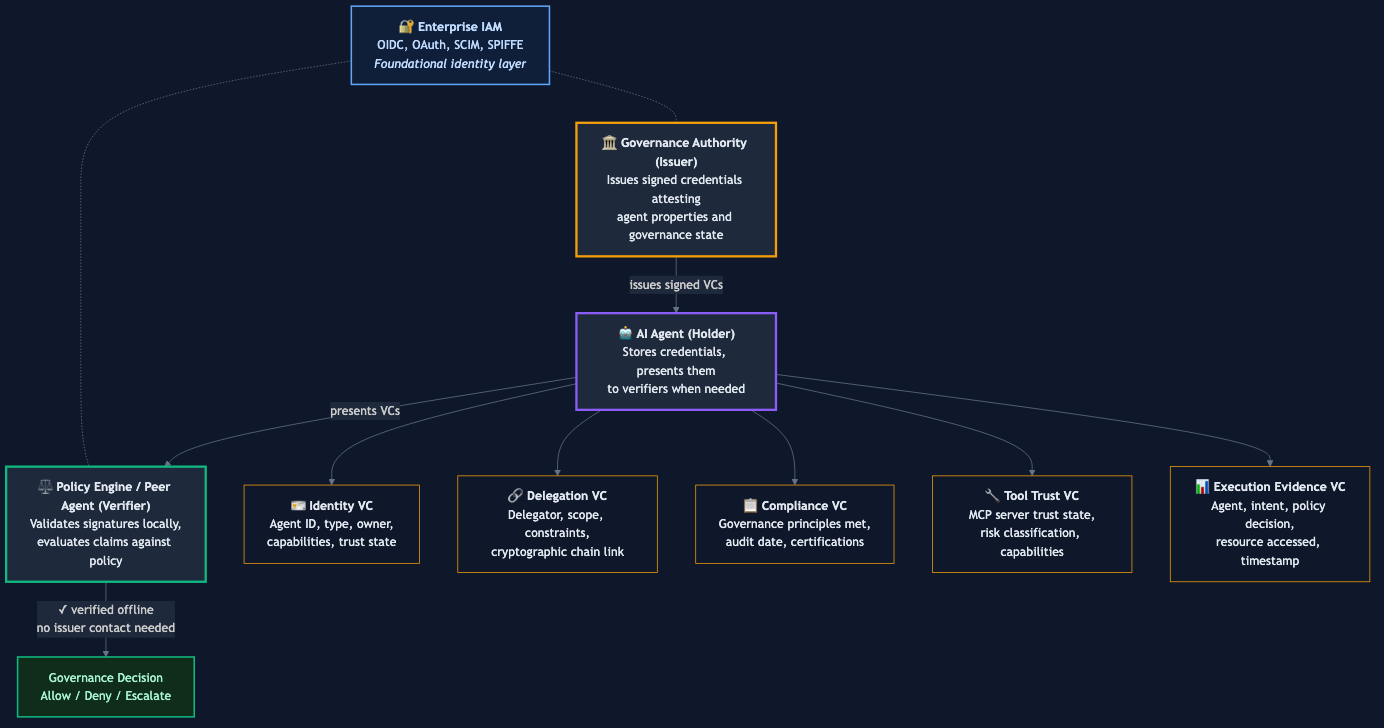
The diagram maps the W3C VC model to agent governance. The Governance Authority (issuer) creates signed credentials attesting to agent properties and governance state. The AI Agent (holder) stores five types of credentials: identity, delegation, compliance, tool trust, and execution evidence. The Policy Engine or Peer Agent (verifier) validates signatures locally and evaluates claims against policy. Enterprise IAM (OIDC, OAuth, SCIM, SPIFFE) provides the foundational identity layer that both issuers and verifiers depend on.
The three roles are compositional. An agent can be a holder of its own identity credential, a verifier of a tool server's trust credential, and participate in issuing delegation credentials to sub-agents. The VC model is flexible enough to support all of these interactions with a single trust framework.
An Agent Runtime Governance control plane like Watchlight AI Beacon is a natural verifier in this model. The policy engine already evaluates agent identity, intent, authority grants, and delegation chains on every action. Adding verifiable credential verification to that evaluation means the control plane can validate cryptographic proof of an agent's governance claims at the moment of every action, using the same policy engine that already governs the action itself. The governance decision and the credential verification happen in the same place, at the same time, with the same context.
How This Fits with Existing Infrastructure
VCs do not replace the identity and access infrastructure enterprises have already built. They extend it.
IAM remains foundational. OIDC authenticates agents. OAuth issues scoped tokens for API access. SCIM provisions and deprovisions agent accounts. These standards handle identity lifecycle. VCs do not replace them.
SPIFFE/SPIRE handles intra-org workload identity. For agents running in Kubernetes clusters, containers, or cloud environments within a single organization, SPIFFE provides excellent attestation-based identity. VCs are not needed for this use case.
VCs add cross-boundary trust. When agents interact with systems, agents, or auditors outside their organization's trust boundary, VCs provide the portable, cryptographically verifiable governance claims that tokens and SVIDs cannot carry across those boundaries.
Agent Runtime Governance consumes all three. The ARG control plane uses identity signals from IAM and SPIFFE, governance claims from VCs, and formal policy evaluation via Cedar to make runtime authorization decisions. Each layer provides different context. Together, they provide the full picture.
The Art of the Possible
The W3C Verifiable Credentials Data Model is a mature standard. BBS signatures enable selective disclosure. Bitstring Status Lists enable privacy-preserving revocation. The cryptographic foundations are production-ready.
What has not yet emerged is industry consensus on how to apply these primitives to agent governance. The credential schemas for agent identity, the delegation chain formats, the compliance attestation profiles, and the tool trust verification protocols are all open questions. The community is still exploring.
We do not know whether the industry will converge on VCs as the primary trust mechanism for agent governance, or whether alternative approaches will prove more practical for specific use cases. What we do know is that the trust challenges are real: agents are beginning to cross organizational boundaries, interact with external tools, delegate to third-party agents, and produce evidence for regulators. The trust model for these interactions needs to be cryptographic, portable, and verifiable without depending on a single authority being online.
Verifiable Credentials are one strong candidate for providing these primitives. We are actively exploring how they compose with Agent Runtime Governance and welcome the community's perspective on where this thinking is incomplete or where alternative approaches may be stronger. The right answers will emerge from the collective expertise of the security, identity, and AI communities working together.
Exploring how to integrate verifiable credentials into your agent governance architecture? Our Agent Authorization & Runtime Control Architecture engagement helps enterprise teams design agent identity, delegation chains, and cryptographic trust models. Download the one-pager (PDF) or discuss an engagement.
To learn more about the governance framework: 12 Non-Negotiable Principles | Agent Runtime Governance | Request a Demo
Subscribe to Watchlight Insights
Get new writing on Agent Runtime Governance, AI agent security, agent identity, and delegated authorization, delivered when we publish. No noise, just the new posts.
Unsubscribe anytime. We never share your email.
Put runtime governance in front of every agent action
Watchlight AI Beacon is available now, fully on-premises and air-gapped. Request a demo to see it in your environment.
Agent Governance Readiness Assessment
Evaluate your governance posture against the 12 principles. Get a maturity score and roadmap.
2-3 days · Download one-pager (PDF)